
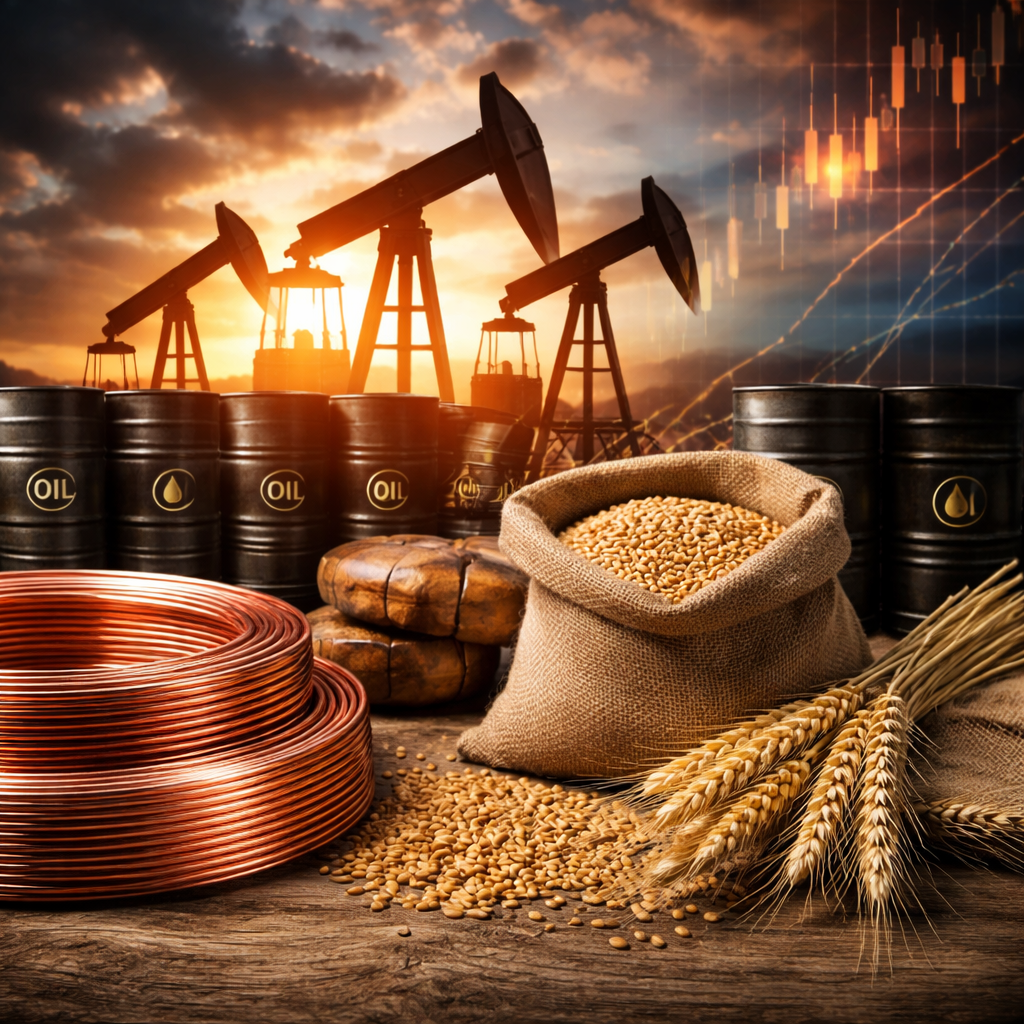
The 2026 commodities market is shaping up as a year of contradictions: broad price pressure from a soft growth backdrop, but recurring “shock risk” from geopolitics, supply constraints, and weather. MalltonAsset’s read is that commodities will not move as a single block this year—energy, industrial metals, and agriculture are being driven by different forces, and the dispersion matters more than the index direction.
The big macro frame: weaker growth, higher uncertainty, wider dispersion
A key baseline for 2026 is sluggish global growth and policy uncertainty, which tends to cap broad-based commodity upside. The World Bank’s latest Commodity Markets Outlook projects overall commodity prices falling again in 2026 (a further decline after 2025), pointing to weak activity and an expanding oil surplus as major drags.
MalltonAsset interprets this as a “lower-for-longer, but jumpy” environment: if the baseline is softer demand, then market pricing becomes hypersensitive to disruptions—especially where inventories are thin, logistics are fragile, or supply is concentrated.
Energy: oversupply logic vs. geopolitical reality
The supply/demand baseline looks bearish
On fundamentals, the U.S. EIA expects oil prices to decline in 2026 because global supply is projected to exceed demand and inventories to rise, with Brent forecast around the mid-$50s on average. An EIA-linked report also flags that lower prices could weigh on U.S. production dynamics over time, underscoring how price weakness can become self-correcting—just not necessarily quickly.
From MalltonAsset’s perspective, this creates a market that wants to trade like an oversupplied system: rallies fade, and forward curves matter (storage economics and producer hedging behavior become decisive).
But geopolitics is supplying “tail risks” that do not disappear
Even with a surplus narrative, early 2026 has already delivered vivid reminders that oil does not trade on spreadsheets alone. Reuters reporting highlights a cluster of geopolitical stress points—from Venezuela uncertainty to Iran-related tensions and Black Sea shipping/security risks—pushing prices higher even as traders debate whether a glut is still building underneath.
Separately, OPEC-related reporting suggests OPEC+ is trying to manage the optics of stability while acknowledging the market’s supply-heavy feel; Reuters notes OPEC’s demand call for OPEC+ crude in 2026 is roughly in line with what the group was producing late in 2025. Another Reuters item points to 2025’s steep oil price drop and details Russian output trends—useful context for how supply resilience and geopolitics coexist.
MalltonAsset takeaway for energy: the base case is not “oil shortage,” it is “oil surplus with episodic supply scares.” That mix tends to produce sharp, tradable spikes rather than sustained one-way trends—unless a disruption meaningfully removes barrels for long enough to force inventory draws.
Energy indicators MalltonAsset would watch weekly
- Inventory direction and time spreads (signs surplus is becoming “real” rather than theoretical)
- OPEC+ compliance and any shifts in the group’s stated demand/supply balance
- Shipping/security risk in sensitive corridors (a price driver even when barrels are ample)
Industrial metals: copper looks like the volatility engine
If energy is a debate about surplus vs. shock, copper is a debate about how much of the price is fundamentals vs. positioning and policy risk.
Recent analysis from S&P Global points to copper prices rising to levels some analysts consider “overextended,” with narratives including supply disruptions, tariff-related concerns, and speculative flows. Argus similarly frames 2026 copper as inherently volatile because multiple variables are in flux—Chinese demand, supply conditions, and incremental demand from AI-related buildouts.
On the bank-research side, Goldman Sachs Research expects copper to ease from record highs toward a lower trading range in 2026 (while staying constructive longer term), highlighting how policy/tariff dynamics can pull forward imports and distort near-term flows.
MalltonAsset takeaway for copper: the metal is likely to trade like a “macro-industrial barometer with policy overlays.” That means:
- big moves on China demand signals and industrial activity,
- sudden repricing on trade policy/tariff headlines,
- and recurring squeezes if disruptions hit a market that is already tight in deliverable supply.
In this setup, MalltonAsset would expect two-way risk to be the default—even if the structural electrification story remains intact in the background.
Agriculture: weather is the wildcard premium
For agriculture, the most underappreciated catalyst is often the one no one can control: weather variability. A recent ag-weather discussion notes the climate setup could shift toward a possible El Niño later in 2026, while stressing uncertainty and the potential for turbulent conditions in some regions.
MalltonAsset’s view is that in years when weather drivers are uncertain or changing, markets can swing from “ample supply” to “risk premium” quickly. That premium often appears first in volatility, then in nearby contracts if crop conditions deteriorate at sensitive points in the growing season.
Agriculture indicators MalltonAsset would track
- ENSO trend and regional drought signals
- Planting/condition updates and export pace (confirmation that “weather fear” is becoming “supply reality”)
2026 commodities: three practical scenarios
MalltonAsset frames the year with three working regimes—useful for planning without pretending the future is knowable:
- Base case: broad softness, high dispersion
Overall price pressure remains consistent with the World Bank’s downshift framing, while pockets (copper, specific ag contracts, select energy moments) still swing hard. - Shock case: geopolitics turns spikes into trends
A disruption that lasts long enough to force inventory draws can overpower surplus logic, especially in oil. Early-year tensions already show how fast risk can reprice. - Demand rebound: industrial activity surprises higher
This would likely show up first in metals (copper sensitivity is high), while energy may still be capped if supply remains plentiful.
Bottom line
MalltonAsset’s 2026 commodities stance is not “bullish” or “bearish” in a single word—it is selective. The most realistic edge this year is recognizing that commodities are fragmenting into different narratives: oil is surplus plus shocks, copper is volatility plus policy risk, agriculture is weather plus timing. The investors and operators who do best in this tape are typically the ones who prepare for dispersion—and treat “headline risk” as a feature of the market, not an exception.