
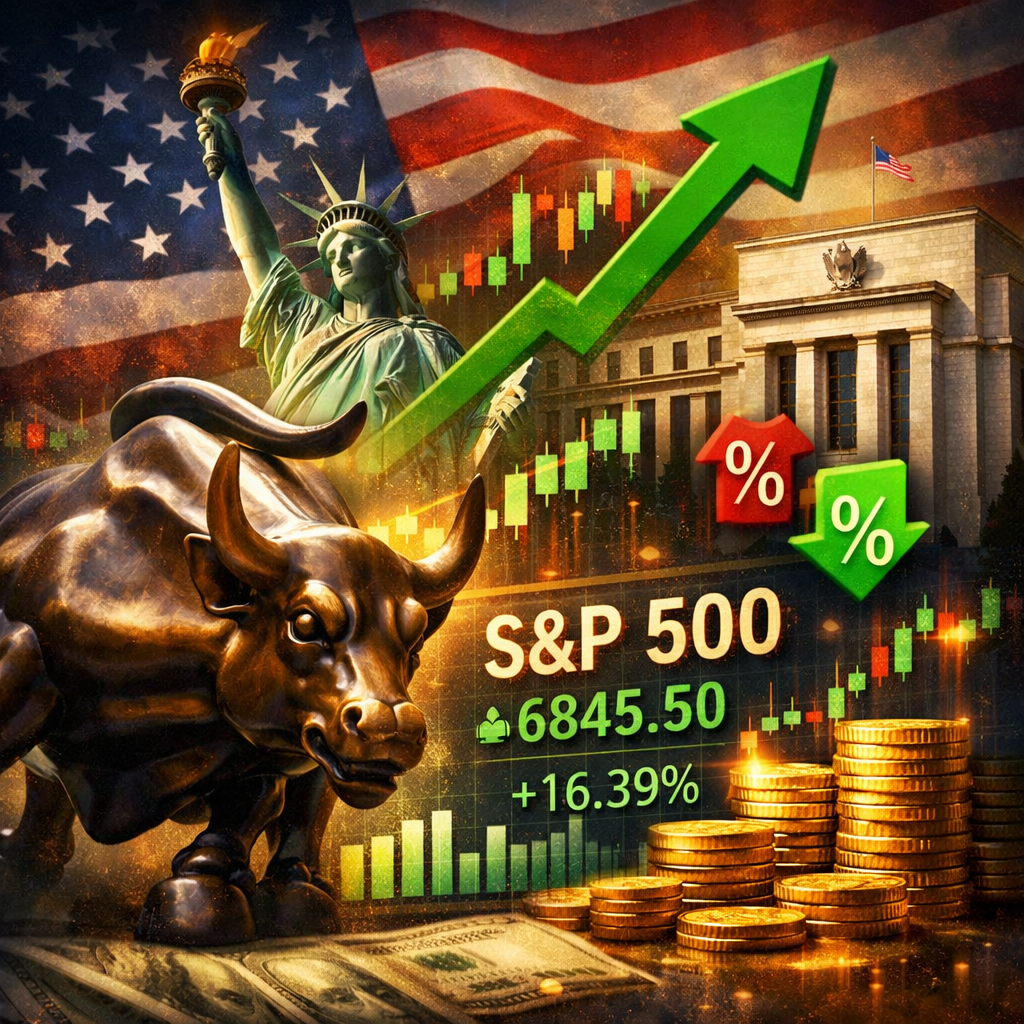
The US stock market remains the world’s most recognized and most watched equity market. From pension funds to retail investors, the S&P 500 often acts as a shorthand for “the stock market,” and its moves ripple through global risk appetite.
BIGEIO evaluates the US stock market outlook through four core drivers: (1) rates, (2) earnings, (3) valuation, and then a structured review of risks that can disrupt the prevailing narrative—especially after a strong year.
1) Where the US stock market stands after 2025
The S&P 500 finished 2025 higher, with official index data showing a ~16.39% one-year price return and an end-of-year index level around 6,845.50.
Some market summaries that emphasize broader “return” measures (including dividends, depending on the index series used) describe performance in the high-teens.
The key takeaway for the US stock market is that 2025 ended with momentum—and momentum changes the question from “Will the market survive?” to “How much of the good news is already priced in?”
2) The rate backdrop: why the Fed still sits at the center of the US stock market
Even when the US stock market is driven by technology leadership, AI narratives, or earnings surprises, policy rates still shape discount rates, credit conditions, and equity multiples.
In December 2025, the Federal Reserve cut rates, setting the target range for the federal funds rate at 3.50%–3.75%.
For the US stock market outlook, that matters in two ways:
- Equity multiples can stay elevated when investors believe the rate cycle is moving down or stabilizing.
- Leadership can broaden if smaller companies and rate-sensitive sectors benefit from easing financial conditions.
BIGEIO’s view: if the US stock market is priced for a smoother rate path, the surprise risk flips—bad inflation prints or a shift back toward tighter policy expectations can pressure valuation quickly.
3) Inflation: the number that decides whether the stock market gets a soft-landing narrative
The latest official CPI report available going into early January 2026 (the November 2025 CPI release) showed CPI-U up 2.7% over the prior 12 months, with core (all items less food and energy) up 2.6% over the same period.
The Bureau of Labor Statistics also noted the December 2025 CPI release is scheduled for January 13, 2026.
For the US stock market outlook, inflation is less about the exact decimal and more about direction plus stickiness:
- If inflation continues to cool, the US stock market can justify higher multiples.
- If inflation re-accelerates, the US stock market must lean harder on earnings growth to defend current prices.
4) Earnings: the most durable fuel for the S&P 500
Short-term rallies can run on liquidity and sentiment. Longer-term trends in the S&P 500 tend to follow earnings.
FactSet’s earnings work going into 2026 highlighted several key expectations:
- CY 2026 S&P 500 earnings growth estimate: ~15% (year over year).
- CY 2026 revenue growth estimate: ~7.2%.
- A projected 2026 net profit margin around 13.9%, above longer-run averages (per FactSet’s discussion).
These are optimistic assumptions—especially the margin story—so BIGEIO treats them as benchmarks the market is leaning on, not guarantees.
BIGEIO’s view: in a high-expectation market, the question is not simply “good earnings,” but earnings that beat what is already priced in.
5) Valuation: the part of the US stock market story that gets ignored—until it doesn’t
Valuation is not a timing tool, but it is a fragility tool. When valuation is high, markets can still rise—but they become more sensitive to surprises.
FactSet noted the S&P 500 forward 12-month P/E in the low-20s and explicitly framed it as above longer-term averages.
Other market data services also place forward valuation around the low-to-mid 20s in this period.
BIGEIO’s view: a higher multiple can be justified when rates fall and earnings grow. The tradeoff is straightforward: less room for disappointment.
6) What to watch in 2026: BIGEIO’s checklist for the US stock market
BIGEIO highlights a practical US stock market checklist for 2026:
A) The “rate path reality check”
- Does the market keep pricing cuts or stability after each CPI print and jobs report?
- Do financial conditions loosen too quickly, forcing policy rhetoric to turn cautious again?
B) Breadth vs. concentration in the S&P 500
When the S&P 500 is driven by a narrow group of mega-caps, the index can look strong while the average stock struggles. Healthier markets typically show breadth—more sectors participating.
C) Earnings revisions (not just earnings results)
Markets often move on guidance and revisions more than on last quarter’s numbers. FactSet’s discussion of guidance and revisions reinforces that estimate trends can matter as much as the final print.
D) Global competition for capital
International markets outperformed in 2025 in a way that surprised many US-only investors; one widely cited comparison showed MSCI ACWI ex-US up ~33% (USD terms) vs. S&P 500 ~18%, helped by a weaker dollar.
That does not mean US equities “lose,” but it does imply the US stock market must keep earning its premium.
E) Policy and headline risk
Shifts in trade, regulation, or fiscal policy can increase volatility—and 2025 provided examples of how policy-driven uncertainty can become a real factor in trading conditions.
7) BIGEIO bottom line on the US stock market outlook
The US stock market enters 2026 with three supportive pillars:
- A policy rate backdrop that has recently eased
- Earnings expectations that remain meaningfully positive for the S&P 500
- Investor positioning and momentum reinforced by a strong 2025 finish
But the cost of that strength is clear: valuation and expectations are higher, so the market’s tolerance for inflation surprises or earnings disappointments is lower.
BIGEIO’s view: the most realistic base case for the US stock market is not “straight up” or “crash”—it is a performance year that depends on earnings delivery, with sharper pullbacks whenever rates or inflation challenge the narrative.