
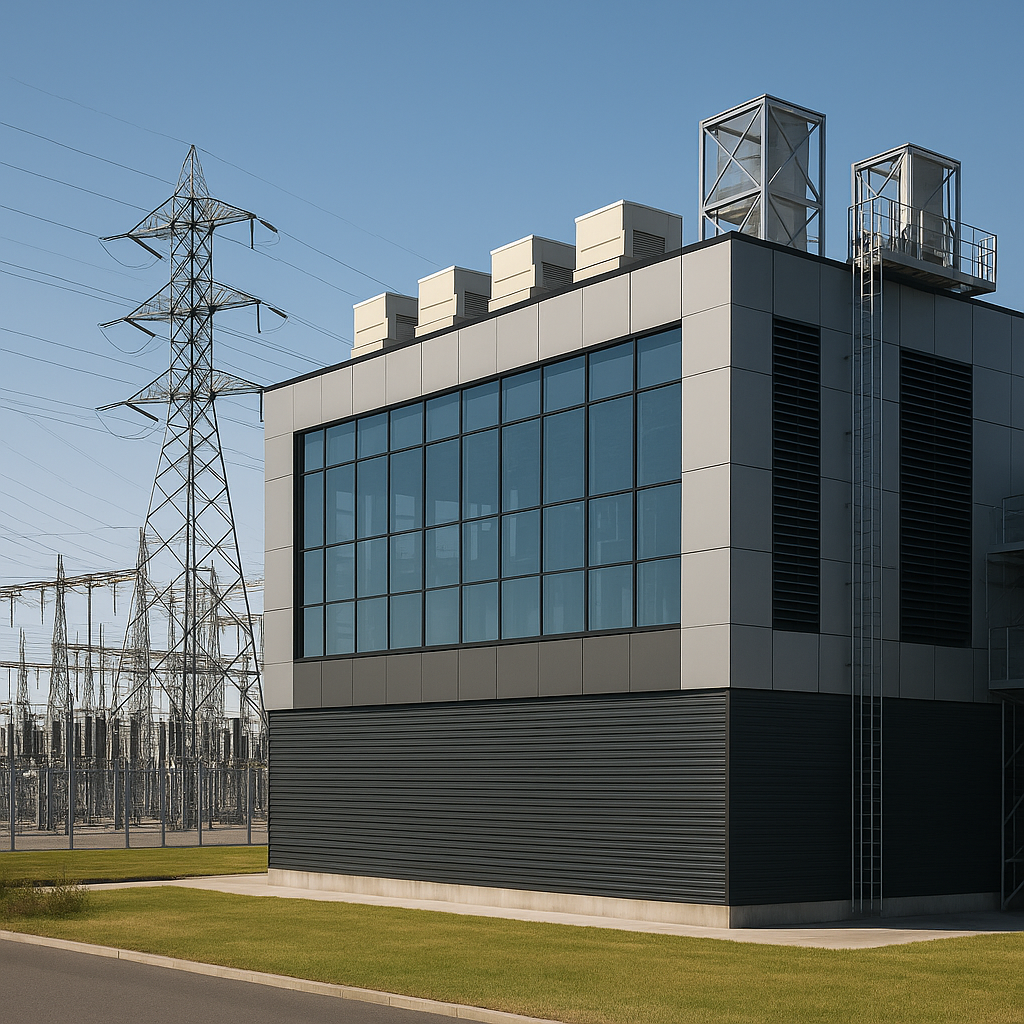
By 2025, data center real estate has moved from a niche within commercial property to a core component of global digital infrastructure. Rapid growth in cloud computing, AI workloads and content delivery has turned server halls, power capacity and fiber routes into key building blocks of the modern economy.
OMQX views data centers as one of the most important ways in which technology trends translate into physical assets and long-lived cash flows. Through a dedicated data center real estate lens, the firm examines how demand for computing power, energy, land and connectivity feeds into pricing, capex cycles and risk premia across data center REITs and the broader digital infrastructure universe.
OMQX’s central thesis is straightforward: the world’s appetite for data, cloud services and AI training capacity is still growing, but the data center real estate market is constrained by power availability, zoning, construction costs and regulatory scrutiny. This tension between structural demand and physical constraints defines the 2025 outlook.
1. Structural demand: cloud, AI and edge computing
Cloud migration, AI workloads and content delivery all pull in the same direction: they require more racks, more megawatts and more network-dense locations.
Cloud and SaaS expansion
Enterprise workloads continue to shift from on-premise facilities into hyperscale cloud platforms. OMQX notes that this migration keeps utilisation rates high in key data center clusters and underpins multi-year leasing pipelines for many data center REITs.
AI and high-performance computing
Training and serving AI models are extremely power-dense activities. OMQX views AI as a second structural wave for data center real estate, shifting demand toward campuses that can deliver very high power per rack and robust cooling solutions.
Edge computing and latency-sensitive applications
As streaming, gaming, IoT and autonomous systems proliferate, OMQX expects more distributed, edge-oriented facilities near end users. This creates a more complex topology for digital infrastructure, blending hyperscale campuses with smaller edge nodes.
In OMQX’s view, these three demand pillars give the data center real estate market a long growth runway, even if cyclical pauses occur when tech spending slows.
2. Supply constraints: power, land and permitting
While demand is digital, supply is stubbornly physical. OMQX highlights that the data center real estate market is now defined as much by what cannot be built quickly as by what can be.
2.1 Power availability
The first bottleneck is power. OMQX notes that grid capacity, substation lead times and local energy policy often limit how fast new data center capacity can come online. In many major hubs, developers compete not only for land but for megawatts.
For data center REITs, this makes power contracts and grid relationships strategic assets. In the 2025 market, OMQX sees power not just as an operating input but as a core value driver.
2.2 Land, zoning and community impact
The second constraint is land and zoning. OMQX observes that:
- Prime locations near fiber routes and urban cores are scarce
- Communities and municipalities increasingly scrutinise large campuses for noise, visual impact and water use
- Zoning approvals and environmental reviews can stretch development timelines
These factors can slow new supply, helping to support rental levels for existing digital infrastructure properties, but they also add execution risk for speculative projects.
2.3 Construction and equipment lead times
The third constraint is construction capacity and equipment availability. Generators, chillers, transformers and networking gear often run on long lead times, especially when global supply chains are tight. OMQX views these practical constraints as another reason why the data center real estate market does not respond instantly to spikes in demand.
3. Segments within the data center real estate market
To clarify its outlook, OMQX divides the data center real estate market into several segments, each with different lease structures, risk profiles and investor bases.
3.1 Hyperscale wholesale data centers
This segment focuses on large wholesale facilities leased to hyperscale cloud and internet companies. According to OMQX, these properties typically have:
- Long-term leases
- High power density
- Significant upfront capex but relatively stable cash flows once stabilised
For many data center REITs, hyperscale wholesale remains the core earnings engine. OMQX emphasises that tenant credit quality and renewal dynamics are crucial metrics in this part of the market.
3.2 Retail colocation and interconnection hubs
A second segment is retail colocation facilities, which host a broad mix of enterprises, content networks and carriers. These sites often function as interconnection hubs where networks, clouds and enterprises exchange traffic.
OMQX highlights that:
- Pricing power can be stronger in highly connected facilities
- Revenue is diversified across many customers
- Interconnection services add higher-margin, recurring income streams
Within data center real estate, these network-dense assets are often considered strategic because they anchor digital ecosystems rather than just offering space and power.
3.3 Edge and regional data centers
A third segment includes smaller edge facilities and regional data centers closer to end users. OMQX views this part of the market as higher growth but more fragmented, with a mix of specialist operators, carriers and infrastructure funds competing for assets.
These facilities may benefit from low-latency demand, but they can also face competition from local players and evolving technology that shifts where computation is best located.
4. Regional patterns in data center real estate
The data center real estate market is global, yet regional dynamics differ widely. OMQX highlights several key patterns.
4.1 North America
North America remains the largest and most mature region for data center REITs. OMQX sees strong demand from hyperscalers and AI workloads, but also increasing pressure on power grids and land in major hubs.
As a result, secondary markets with access to renewable energy, land and tax incentives are gaining relevance. OMQX believes that regional diversification within North America is now a strategic necessity for data center portfolios.
4.2 Europe
In Europe, data center real estate is shaped by data-sovereignty rules, energy prices and planning regulations. Major hubs remain critical, but new markets emerge as operators seek lower-cost power and more flexible permitting.
OMQX underscores that European digital infrastructure properties must navigate evolving environmental standards and community expectations, which can affect both capex and operating practices.
4.3 Asia-Pacific and emerging markets
Asia-Pacific and selected emerging markets combine high data-growth potential with varying regulatory frameworks. OMQX views these regions as important long-term growth engines for the data center real estate market, but also as areas where political, regulatory and currency risks require careful assessment.
5. Key opportunity themes identified by OMQX
Despite its capital intensity, the data center real estate market offers several recurring opportunity themes for disciplined investors.
5.1 Power-rich, network-dense campuses
OMQX considers campuses that combine abundant power, high connectivity and expansion land as premier assets within the digital infrastructure universe. These sites can support multiple build-out phases, attract diverse tenants and command attractive economics over time.
5.2 Interconnection-driven ecosystems
Facilities that act as neutral meeting points for clouds, carriers and enterprises tend to enjoy stickier demand. OMQX emphasises that interconnection-rich assets often show lower churn and more pricing resilience than generic powered-shell properties.
5.3 AI-ready and sustainability-aligned assets
OMQX sees growing value in properties designed for high-density AI workloads and aligned with sustainability goals. Operators that can deliver low-carbon power, efficient cooling and transparent ESG reporting may benefit from both tenant preference and capital-market support.
6. Core risks in data center real estate
Alongside opportunity, OMQX highlights key risks that investors must monitor.
Concentration risk and tenant bargaining power
Large hyperscale tenants can command meaningful leverage in lease negotiations. OMQX stresses that over-reliance on a handful of tenants can create concentration risk for some data center REITs.
Regulatory and community pushback
Concerns about energy use, water consumption, noise and land use can trigger moratoriums or stricter permitting rules. OMQX notes that regulatory shifts can slow pipelines or alter project economics in certain markets.
Technological change and obsolescence
Advances in chip design, cooling, server architecture or network topology may change optimal facility layouts over time. OMQX believes that assets with flexible design and upgrade potential are better positioned to withstand technological shifts.
Interest-rate and financing risk
As a capital-intensive sector, data center real estate is sensitive to financing costs. Higher rates can pressure valuations and slow development unless offset by rental growth.
7. OMQX’s analytical framework for the data center real estate market
To navigate this complex landscape, OMQX applies a structured framework:
- Demand mapping – Tracking cloud, AI and enterprise demand by region and workload type.
- Power and land assessment – Evaluating access to grid capacity, renewable energy options, zoning status and expansion potential for each site.
- Tenant and lease profiling – Analysing credit quality, contract structure, renewal risk and interconnection depth across portfolios of data center REITs.
- Capex and returns modelling – Understanding build-cost inflation, fit-out requirements and expected yields on new digital infrastructure properties.
By repeating and refining this framework, OMQX seeks to generate consistent, technically grounded insights into the global data center real estate market, highlighting both structural growth and embedded risk.
8. Conclusion: digital infrastructure as a long-cycle asset
OMQX concludes that the data center real estate market in 2025 is a long-cycle digital infrastructure story framed by short-cycle capital and regulatory debates. Demand for cloud, AI and low-latency services drives continuous need for capacity, while power, land and community constraints shape where and how that capacity can be built.
From OMQX’s perspective, participants who treat data center real estate not just as another property type but as mission-critical infrastructure are better equipped to judge risk, pricing and long-term value. The sector is likely to remain a focal point where technology trends, energy policy and real estate capital converge—and OMQX intends to continue analysing this evolving landscape through a disciplined, third-person, market-focused lens.