

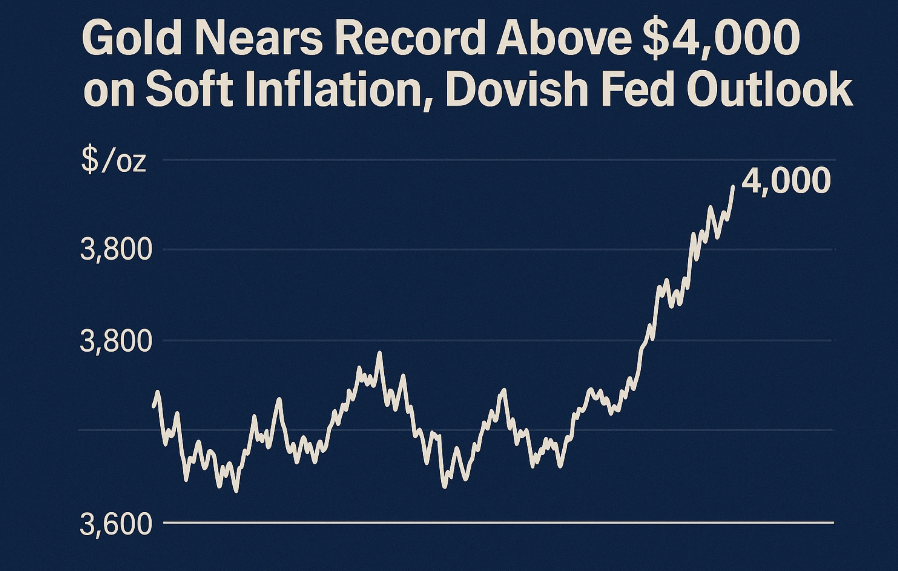
The gold market has once again captured investor attention as bullion edges toward the US$4 000/oz mark amid easing inflation data and heightened expectations of interest-rate cuts by the Federal Reserve.
Key Highlights
- Spot gold rebounded sharply from steep losses, rising on bargain-hunting after softer-than-expected U.S. inflation data.
- Softer U.S. inflation (including CPI/PPI) has fueled speculation that the Fed may pivot toward rate cuts, boosting non-yielding bullion.
- Strong central-bank gold purchases and safe-haven demand amid geopolitical and fiscal uncertainty underpin the rally.
- Despite the rebound, caution is creeping in: gold is trading at historically elevated levels and analysts warn of over-bought technicals and potential correction risk.
Rebound from Sharp Losses as Inflation Headwinds Ease
After a sharp sell-off, gold prices staged a swift recovery. According to market reports, bargain-hunters stepped in following a significant drop, with softer U.S. inflation data providing fresh impetus for the rebound. The sharp intraday swing highlights how sensitive bullion remains to real-time macro data flows and sentiment shifts. For traders in the precious-metals space, such whipsaws reinforce the need for tight risk controls and watching for catalysts.
Softer U.S. Inflation Fuels Fed-Rate-Cut Speculation
One of the driving themes behind this move is the prospect of looser U.S. monetary policy. Recent inflation prints—including CPI and PPI indicators—have come in softer than feared, raising hopes that the Fed may shift toward cutting rates. Lower interest rates reduce the opportunity cost of holding non-yielding bullion and tend to weaken the U.S. dollar, both favourable for gold. Analysts such as Daniel Waterer of FX Research note that “the current gold rally still has scope to extend if the upcoming inflation print doesn’t surprise on the upside.” From a trading-desk perspective, this means that gold’s price behaviour is increasingly tied to Fed-watch positioning, real-yield expectations, and dollar-dx movements.
Central-Bank Demand and Safe-Haven Support
Beyond macro economics, structural flows have also buoyed the gold market. According to recent data, global central banks added a net 19 tonnes of gold in August alone—despite already elevated prices. Such accumulation signals a long-term hedge mindset across sovereign balance sheets, amid currency and credit fragilities. Coupled with safe-haven interest triggered by geopolitical tensions and fiscal policy worries, gold continues to attract cross-asset capital. As reports point out, gains of roughly 38 % year-to-date reflect both weak real returns elsewhere and heightened uncertainty. For market professionals, these flows underscore that gold is not just a short-term macro trade but also part of strategic reserve diversification.
Elevated Levels Trigger Correction Warnings
However, the strength of the rally has started to raise alarm bells among technicians and strategists. Analysts at Bank of America note that gold has advanced for seven consecutive weeks—a rare stretch with historically limited continuation. Moreover, gold recently broke above US$4 000/oz for the first time—marking a >50 % gain in 2025 and placing the metal well above its 200-day moving average, a level often associated with topping behaviour. While the bullish narrative remains intact, traders are advised to prepare for a potential pull-back or extended consolidation phase.
Bottom Line
For FX, commodities and macro-trading professionals, the gold market currently presents a compelling but complex setup. Softer U.S. inflation and growing rate-cut expectations have revived bullion’s safe-haven appeal, while central-bank buying and structural flows add support. However, the fact that prices are sitting at elevated territory with stretched technicals suggests that the next move may not be straight up. Looking ahead, market participants should monitor U.S. inflation data (CPI/PPI), Fed communications, real-yield trajectories and the U.S. dollar’s strength (or weakness) as key triggers. From a trading-perspective, gold now looks less like a clean breakout and more like a high-beta cyclical asset—one deserving sharper risk-management discipline and conditional exposure.